
Beirut 1983
The deadliest terrorist attack on Americans before 9/11 - ordered by Iran.

This is Part 10 of 20 of my ongoing series covering some of the worst terrorist attacks in modern history and the innocent people whose lives were stolen.
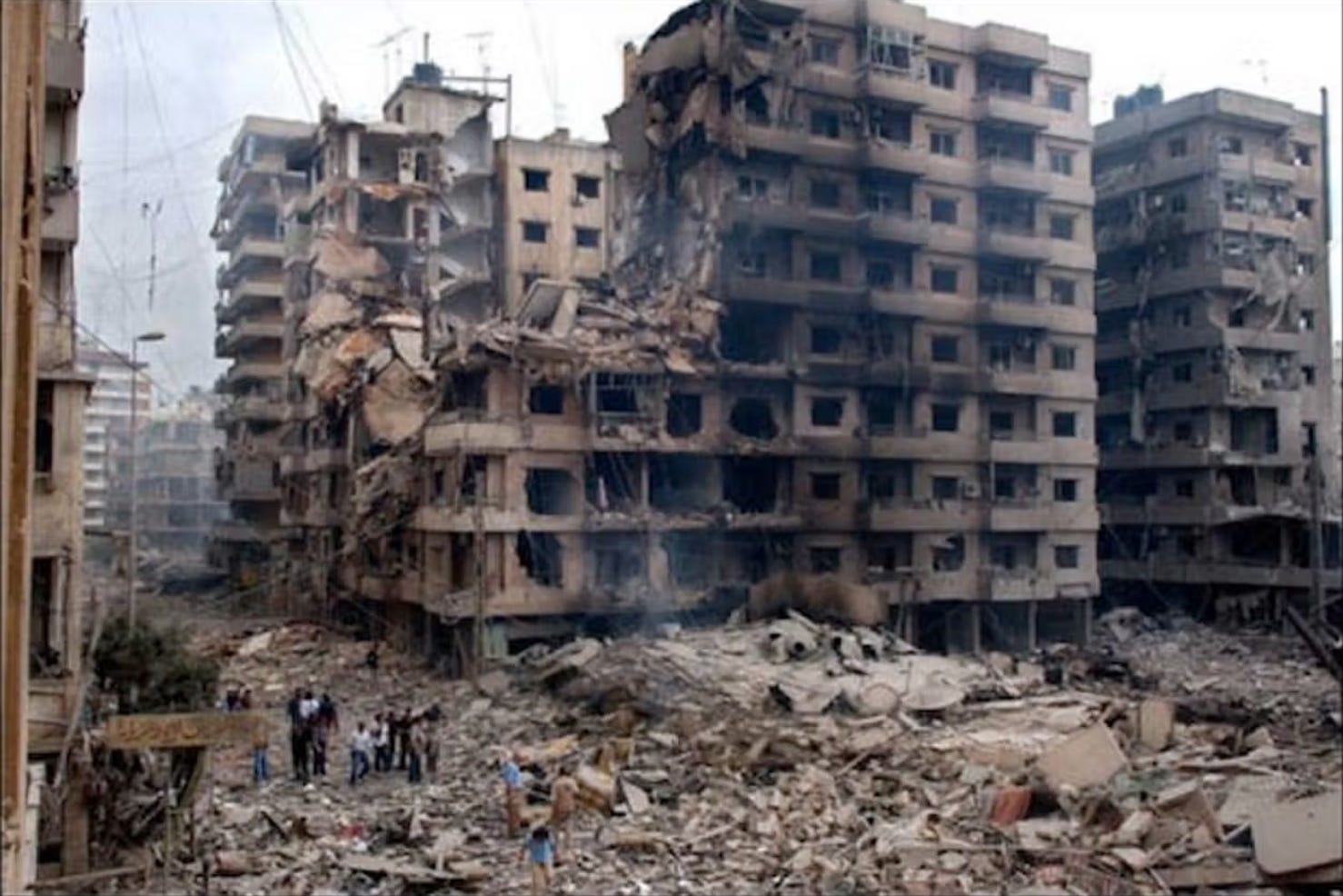
On the morning of October 23, 1983, a Sunday, most of the men in the four-story Marine barracks at Beirut International Airport were still asleep. It was 6:22 a.m. Corporal Chip Shields was in his bunk. Dale Garner was in his room with fourteen other Marines. Navy hospital corpsman James Edward Brown was at his post in the sick hall, about two hundred yards away. None of them heard the yellow Mercedes truck coming.
The bomb was roughly 12,000 pounds. On detonation, it took the four-story barracks and blew it a story and a half into the air. Then it came down.
For two and a half hours, Chip Shields was underneath the rubble with his knees on his chest. At the beginning, everyone was screaming for help. Dale Garner’s building went from a four-story structure to a 25-foot pile of rubble. Of the 15 men in his room, he was the sole survivor. James Edward Brown woke up falling to the floor, surrounded by the crash of isopropyl alcohol bottles and a gust of wind blowing through shattered windows. He grabbed his boots and flak jacket and ran out, not knowing what to expect. When he got there, he saw a four-story building that was now one story tall — walls blown outward, ceilings pancaked on top of each other, everyone in the basement buried in rubble.
The attack killed 241 American service members - 220 Marines, 18 sailors, and 3 soldiers. It was the deadliest single day for the United States Marine Corps since the Battle of Iwo Jima in World War II. Most of these men had enlisted as teenagers. Most of them were buried before their twenty-fifth birthdays. Their names are on a memorial wall in Jacksonville, North Carolina, above the words: They Came in Peace.
How It Happened and Who Was Behind It
